

Grof® Legacy Training Adria
A multi-year experiential training in transpersonal psychology and Grof® Breathwork facilitation
This is a comprehensive training in transpersonal psychology and Grof® Breathwork facilitation, with pathways into advanced training in psychedelic facilitation.
Rooted in the Grof® lineage and more than six decades of research into transpersonal psychology and holotropic states of consciousness — expanded states with healing, transformative, and heuristic potential — the programme is part of the international Grof Legacy Training established by Stanislav and Brigitte Grof and held under their ongoing guidance. It cultivates psychological depth, relational capacity, and ethical discernment through reflective learning and immersive practice, with Grof® Breathwork serving as the central experiential modality.
The programme is held by facilitators with backgrounds in experiential psychology, breathwork, and relational work, with strong emphasis placed on responsibility, reflection, and lived experience. Throughout the training, participants learn and practice attuned presence and supportive bodywork as integral aspects of working with holotropic states of consciousness. Within this process, certification as a Grof® Breathwork facilitator may unfold through the completion of all training requirements.
Further information on the programme structure, modules, requirements, and learning journey can be found in the Practical Info section, which outlines how the training unfolds across its phases.
THE WORK

Rooted in six decades of research in Transpersonal Psychology, the training approaches expanded states of consciousness as meaningful expressions of the psyche — carrying emotional, psychological, and existential dimensions worthy of careful attention.
Participants develop the capacity to remain present with these experiences, relate to them without avoidance or control, and integrate what emerges over time.
At each person’s own pace, the training supports deeper self-knowledge alongside the professional presence and ethical readiness required for this work.
PROGRAM STRUCTURE

A structured, cohort-based journey unfolding over three years, with space between modules for reflection, integration, and professional and personal development.
Each module combines theoretical foundations with experiential practice, cultivating presence, relational depth, inquiry, and practical application.
Further information on the programme structure, modules, requirements, and learning journey can be found here.
IS THIS FOR YOU?

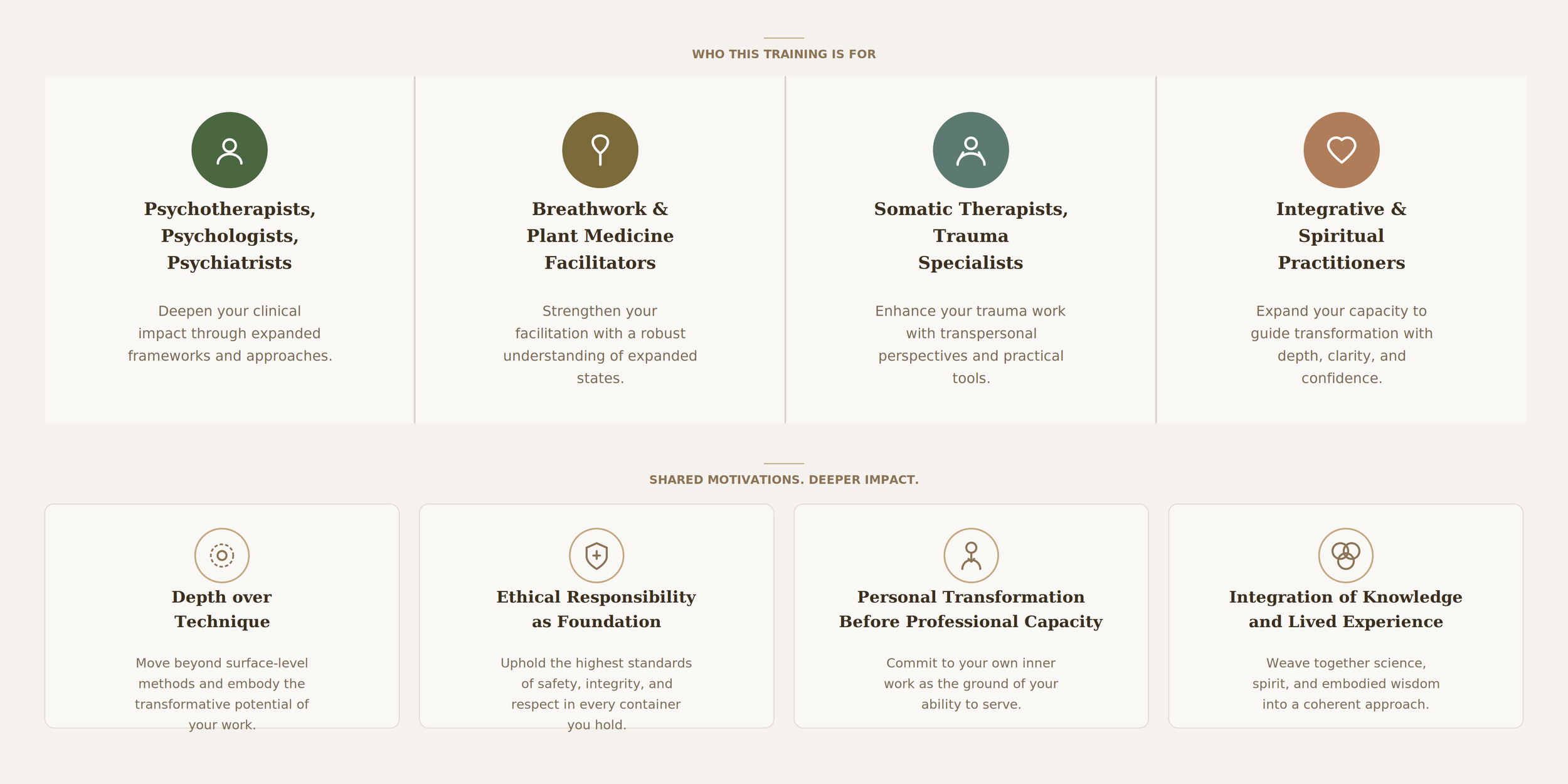
The training is for people with an established commitment to inner work — from psychotherapy, somatic practice, coaching, contemplative traditions, or sustained personal exploration.
What they share is a desire to engage deeply with the human psyche and develop the reflective, relational, and ethical capacities required to work with expanded states of consciousness.
Prior experience provides the foundation. The training develops depth, responsibility, and the capacity for meaningful integration over time.

Three foundational dimensions
This training is held through three foundational dimensions that together support a structured, experiential, and relational approach to working with consciousness.
Each dimension offers a different entry point — from direct experience, to theoretical understanding, to the development of ethical and relational capacity in practice.
-
Participants engage directly in structured experiential processes, primarily through Grof® Breathwork, where psychologically meaningful material may emerge. These processes are held within a carefully tended environment — one that prioritises safety, non-interference, and attentive respect for each person’s unfolding experience. Throughout the training, participants cultivate presence, attunement, and the foundations of supportive bodywork as integral aspects of the learning process.
-
Modern consciousness research, transpersonal psychology, and Grof's expanded cartography of the psyche offer orientation and context for what is encountered experientially. These frameworks illuminate rather than prescribe — supporting exploration and reflection while remaining open to the complexity and uniqueness of each person’s experience.
-
The facilitation capacity develops through presence, observation, and sustained participation in a shared field of learning. Alongside experienced facilitators, participants cultivate attunement, a felt sense of appropriate boundaries, and the ethical discernment that can only be embodied over time.

What you will develop
Throughout the training, participants develop key capacities that support both personal integration and responsible engagement in this field of work:
Capacity to remain present with oneself and others in expanded and intense psychological states
Understanding of transpersonal psychology and its experiential and clinical implications
Relational attunement and supportive bodywork in service of experiential processes
Integration practices for both personal and professional application
Ethical and relational discernment in facilitation contexts
Considering the Training
Readiness for this training is shaped less by credentials, experience level, or professional background, and more by one’s current relationship to inner work — including the capacity for self-reflection, emotional responsibility, and engagement in a longer-term developmental process. The training is intended for individuals drawn toward sustained experiential inquiry, relational learning, and gradual personal and professional formation.
Readiness
Reflect on your readiness for this training and its level of engagement.
Webinars
Learn more about the structure, approach, format and FAQs.
Application
Apply and complete a short self-reflection as part of the process.

The Journey
The training unfolds gradually, with each stage deepening personal and relational growth.
Alignment And Orientation
The training begins with inquiry and orientation and continues as a developmental process through immersive practice, reflective integration, supported facilitation experience, and long-term professional development.
Along the way, participants deepen their capacity to remain present with uncertainty, engage responsibly with holotropic states of consciousness and supportive bodywork, while cultivating the relational and ethical foundations of facilitation in the Grof® lineage.
If this speaks to you, the first step is to get a clear sense of alignment. As part of the application process, you will be invited to complete a short self-assessment and, if you feel called, attend one of our monthly introductory webinars .
This offers insight into the work, the expectations of the training, and whether this path feels aligned with your current stage of development.
You can also explore the training schedule, module descriptions, and further practical information before deciding to apply.

The Journey
The in-person parts of the training will take place in Slovenia, a land where the Alps descend toward the Adriatic, and where Central Europe and the Mediterranean continue meeting and influencing one another. The journey begins with a six-day Introduction Module — a space to arrive, settle, and orient.
Introduction Module
Oct 13 - 18, 2026 (Gozd Martuljek, Slovenia)
(Gozd–Martuljek is a 45 min drive from Ljubljana airport)
The training then continues through six additional residential modules, held over the following three years at a rhythm of two modules per year.
2027 Modules: Mar 30 – Apr 04 and Sep 16 - 21
ETHICS & SAFETY

Working with expanded states of consciousness requires careful attention to safety, boundaries, and ethical responsibility. Experiential processes may involve emotional intensity and deep psychological material, approached with patience, care, and respect.
Participants learn within a structured, attentive environment grounded in clear boundaries, non-directive facilitation, compassionate feedback, and ongoing integration. Each person is supported to move through their process at their own pace.
Over time, the training develops the relational and ethical capacities required to work responsibly with oneself and, ultimately, with others.
What this training is not
This trining is not psychotherapy or clinical treatment.
It is not a conventional certification program, nor a method course, nor a shortcut.
Development at this level requires time, repetition, and genuine integration - and the training is designed with that understanding at its core.

WHY THIS MATTERS NOW
Access to expanded states of consciousness has grown rapidly through breathwork, psychedelics, meditation, and somatic practices. But preparation, skilled accompaniment, and integration have not always kept pace.
This creates a growing gap between access and responsibility — and a need for practitioners equipped to meet these experiences with depth, care, and ethical grounding.
GLTA addresses this gap by developing the psychological, relational, and ethical capacities needed to work with expanded states of consciousness in a grounded and sustainable way.
The training supports practitioners to carry this work into their communities with discernment, skill, and responsibility.
THE ADRIA REGION

This training is rooted in a part of Europe shaped by many histories, cultures, and encounters — a region where depth, complexity, and resilience are woven into everyday life, and where questions of belonging, identity, and connection continue to unfold.
Bringing this work here opens a space for it to reach those who have not always had easy access to such containers. It offers a context where personal and collective layers of experience can be met with compassion and care.
The training also welcomes participants from a wide range of cultural backgrounds, forming an international community of practice held together by shared human experience. Within this space, differences meet once again, alongside a deeper recognition of what connects us, continuing a long tradition of cultural encounters in this region.
In this way, the program contributes not only to the formation of skilled and ethical facilitators, but to something quieter and perhaps equally important: the gradual restoration of connection - within individuals, between people, and across contexts long shaped by both separation and exchange.
APPLY
Once you are ready to apply
The application process is designed to create mutual clarity. Rather than a test or assessment to be passed, it is the beginning of a shared inquiry into whether this training is aligned with where you are at this point in your life and development.
There are no “right” answers. What matters most is honesty, self-reflection, and your willingness to engage with the questions thoughtfully and sincerely.
Time Commitment
This application takes approximately 20–30 minutes to complete with care. We encourage you to take your time — there is no need to rush the process.